
Scarcity Is a Systems Architect
What a GPU-poor lab’s serving stack reveals about misaligned goals across AI infrastructure

On July 9, 2026, SemiAnalysis published a line that aged badly in record time. In a report on Meta’s Superintelligence Labs, the research firm wrote that Chinese labs are “simply too compute poor” to truly reach the frontier. Seven days later, Moonshot AI, a Beijing startup with roughly 300 employees, released Kimi-K3, a 2.8-trillion-parameter model that took the top spot on Arena.ai’s Frontend Code Arena with a score of 1,679, ahead of Claude Fable 5, GPT-5.6 Sol, and every other American model on the board.
The obvious story is the leaderboard; the better story is the infrastructure underneath.
Moonshot did not close the distance with American labs by acquiring more compute. It did so by building software that treats compute as precious (because for Moonshot, compute is precious). The company’s inference stack, an open-source system called Mooncake, was engineered to squeeze usable capacity out of hardware the company could not expand. A DeepMind researcher, Anika Somaia, made the point bluntly the day K3’s leaderboard result landed: Mooncake exists because Moonshot doesn’t have GPUs.
This piece makes three arguments. First, that Mooncake and the K3 architecture are a case study in what scarcity does to engineering culture. Second, that American AI infrastructure, sitting on the largest clusters ever assembled, tolerates waste that would be existential for a Chinese lab. Third, that the policy conclusion most people are drawing from K3 is backwards. Export controls did not fail to stop Moonshot. They functioned as a forced R&D subsidy for Chinese systems software, while leaving untouched the thing America actually holds: the capacity to serve models at scale.
What the reaction got right and wrong
The stakes here are not subtle. The United States has spent four years restricting China’s access to AI chips on the theory that compute determines capability, hyperscalers are spending over $650 billion this year in the same direction, and the Philadelphia Semiconductor Index dropped into a bear market within a day of K3’s release because the theory suddenly looked shaky. If a 300-person lab under export controls can match American frontier models, the premise behind both the policy and the capex is wrong, and a lot of capital and statecraft is aimed at the wrong target.
The reaction on X sorted into two camps within hours. One camp declared the compute moat dead, that “the frontier is no longer something money can buy.” The other camp explained the result away as benchmark tuning and distillation from American models.
imo, both camps are arguing about the wrong layer. The first camp is right that training compressed but wrong beyond (K3’s pricing shows Moonshot hitting a wall forced by capacity limits). The second camp is right that leaderboard placement overstates the model (K3 trails American models on the hardest reasoning benchmarks), but wrong to treat the engineering as fake (the architecture work is real, published, and already being adopted by American serving stacks). What neither camp discusses is the part I work in, which is what the constraint did to Moonshot’s infrastructure engineering, and what the absence of constraint has done to American models. That is the focus of the rest of this piece.
What Mooncake actually is
Every LLM request has two phases that impact the underlying hardware differently.
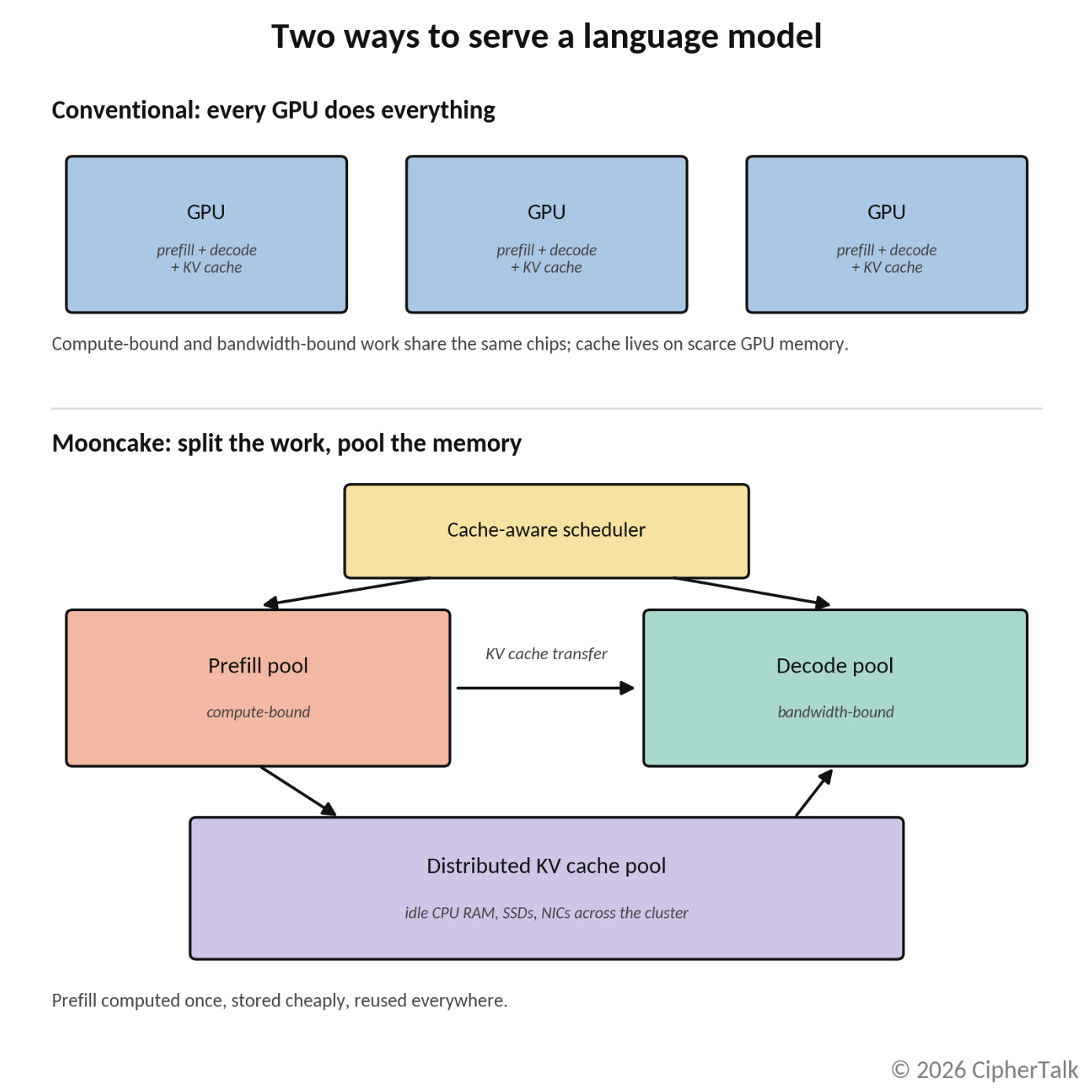
The first phase, prefill, reads your entire prompt and builds an internal working memory of it, a structure called the KV cache. Prefill is compute-hungry: the chip’s arithmetic units are the bottleneck.
The second phase, decode, generates the response one token at a time, and each token requires reading that cached memory back. Decode is bandwidth-hungry: the bottleneck is how fast the chip can move data, not how fast it can multiply.
Most serving systems historically ran both phases on the same GPUs, which means the hardware is mismatched to the work at least half the time. A GPU doing decode has arithmetic units idling. A GPU interrupted by a new prompt’s prefill stalls the users mid-generation. Most ate this inefficiency and bought more GPUs.
Moonshot could not buy more. Mooncake, the serving platform behind the Kimi chatbot, splits the two phases onto separate pools of machines, then builds the entire system around the KV cache as the central object. Prefill nodes compute the cache and ship it to decode nodes. Cached prompt prefixes are stored not on scarce GPU memory but on the CPU RAM, SSDs, and network cards that sit underused in every GPU server, forming a distributed cache pool out of hardware the company already owned. A scheduler routes each incoming request to wherever the largest fraction of its prompt is already cached, so the expensive prefill work is done once and reused. Mooncake’s engineers write about overload as their normal operating condition rather than an edge case. The system predicts which requests it cannot serve within latency targets and rejects them early, before they waste compute that a servable request could have used.
